The diagram below shows how FINOS Common Cloud Controls moves from raw cloud provider documentation to published, testable governance artifacts. Each horizontal band is a stage in the pipeline: inputs on the left, a central authoring step, and catalog releases or tooling outputs on the right. The curved arrows show how each release feeds the next stage.
Note: This architecture combines a best-of-both-worlds approach using AI skills for drafting at each stage and then expert review and approval as a release gate. Through this mechanism we hope to stay up-to-date with the latest advisories and governance as the threat landscape evolves.
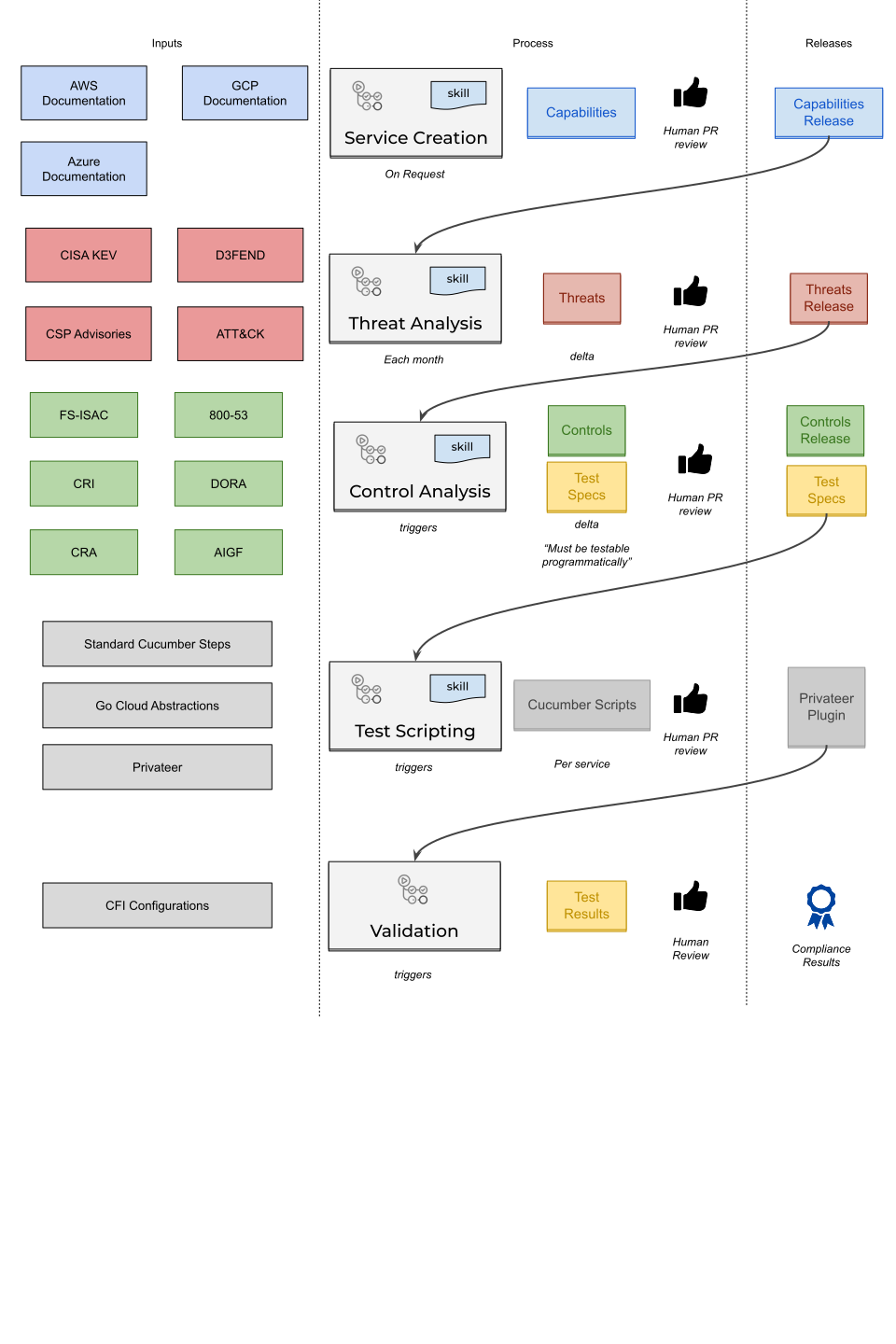
1. Service Creation
Inputs: AWS, GCP, and Azure official documentation.
Process: Service Creation — typically assisted by the create-capability-catalogue Cursor skill, which maps equivalent offerings across clouds and drafts provider-neutral capability definitions.
Outputs: A Capabilities catalog (capabilities.yaml + metadata.yaml) and a versioned Capabilities Release — a compiled Gemara artifact ready for validation and publishing.
At this stage the team identifies what the cloud service does in technology-agnostic terms: the features and properties that matter for security and governance, independent of any single provider's naming or API surface.
2. Threat Analysis
Inputs: External threat intelligence and frameworks — CISA KEV, MITRE D3FEND, cloud service provider advisories, and MITRE ATT&CK.
Process: Threat Analysis — grounding service-specific threats in recognised attack patterns and advisory data rather than inventing risks in isolation.
Outputs: A Threats catalog linked to the capabilities from stage 1, plus a Threats Release published alongside the capability artifact.
Each threat describes a realistic way the service could be misused or attacked, mapped to the capabilities it endangers and to external references where possible.
3. Control Analysis
Inputs: Regulatory and industry frameworks — FS-ISAC guidance, NIST SP 800-53, CRI, DORA, CRA, and the FINOS AI Governance Framework (AIGF) where relevant.
Process: Control Analysis — defining controls that mitigate the threats identified in stage 2, each with clear objectives and assessment requirements (testable statements of what "compliant" looks like).
Outputs:
- Controls and Controls Release — the control catalog and its published Gemara artifact.
- Test Specs — assessment requirements extracted as the specification input for behavioural and policy testing (shown twice in the diagram: as draft specs alongside controls, and again as published artifacts tied to the release).
This is where abstract compliance expectations become concrete, reusable control definitions with explicit test criteria.
4. Test Scripting
Inputs:
- Standard Cucumber Steps — generic step library for calling APIs and asserting on results.
- Go Cloud Abstractions (
cloud-api) — provider-agnostic service interfaces so the same scenario runs on AWS, Azure, or GCP. - Privateer — the compliance test harness that orchestrates runs and produces Gemara-formatted output.
Process: Test Scripting — translating assessment requirements into executable Gherkin feature files and, where needed, provider-specific test plugins.
Outputs: Cucumber Scripts (.feature files mapped to assessment requirement IDs) and a Privateer Plugin that wires those scenarios into the CFI test suite.
5. Validation
Inputs: CFI Configurations — action configs that describe which catalog release to test, which cloud provider and service to target, and which credentials or integration environment to use.
Process: Validation — running the scripted tests continuously in the FINOS integration environment (see Test Results). Unlike earlier stages, this step is fully automated through GitHub Actions rather than an authoring skill.
Outputs: Test Results — HTML, OCSF, and Gemara reports published to the CCC website, demonstrating whether live infrastructure meets the assessment requirements defined upstream.
The ribbon at the end of the diagram represents assurance: evidence that the catalog's controls hold in practice, not just on paper.
How the pieces connect
| Stage | Catalog or artifact produced | Consumed by |
|---|---|---|
| Service Creation | Capabilities Release | Threat Analysis, website catalog browser |
| Threat Analysis | Threats Release | Control Analysis |
| Control Analysis | Controls Release + Test Specs | Test Scripting, CSPM integrations |
| Test Scripting | Cucumber Scripts + Privateer Plugin | Validation CI |
| Validation | Test Results | Auditors, adopters, Test Results page |
Authoring stages (1–4) happen in the catalogs/ tree and supporting modules; compilation and release are handled by the delivery-toolkit and GitHub release workflows; the website you are reading compiles those releases for browsing via npm run generate:catalogs.